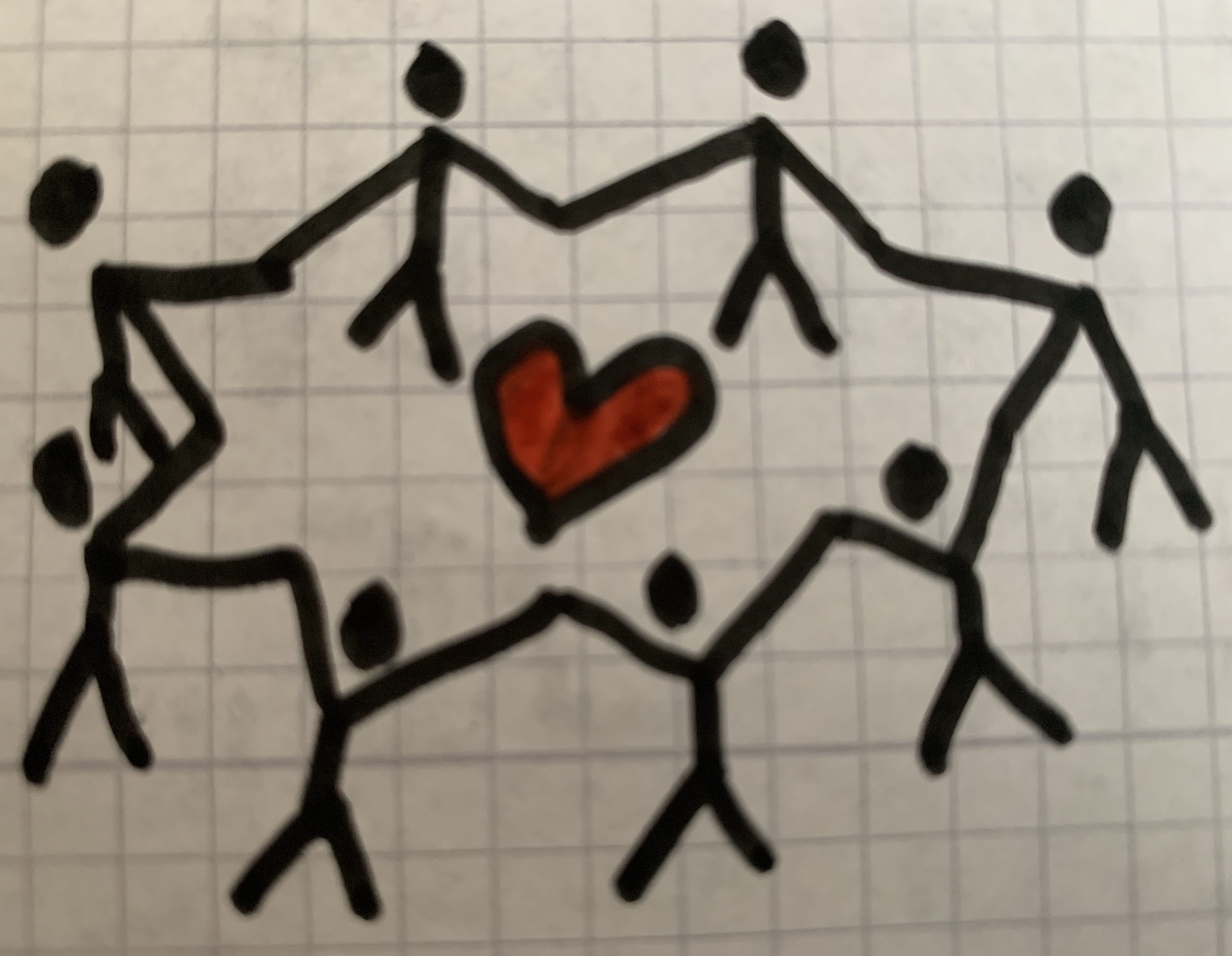
August 13: Day 1 of my fast, day 536 of our chain.
If we look back at the past 70 years, we have come a long way from highly authoritarian, segregated forms of living. My grandparents in India each had only enough education to help them read, write and count (my grandfathers equated math skills with accountancy, and that translated to the speed with which one could add, subtract, multiply and divide large numbers). My grandmothers groomed their daughters to be demure for a dependent future in which they would be expected to constantly de-prioritize their own goals for the comfort of others, mostly men. And the men were constantly under pressure to adhere to external standards of masculinity and toughness and resourcefulness that more often than not disregarded their own deep callings. My parents, the descendants of this mindset, grew up with more education, and fewer social constraints. On the one hand, this felt like less security, but on the other it freed them to actually experience the world around them on their own terms and create their own niche in it as a team. My brother and I grew up with even fewer social constraints, had greater access to the world of ideas and possibilities, and were able to use our freedom to take greater risks, explore different realities, and recalibrate our value systems to be more inclusive and open to change.
While I can only speak for myself, I think the above trajectory is true for a larger proportion of the world’s population today than in previous generations. We have successfully moved away from navel-gazing clannishness, and are open to learning fascinating new things from those different from ourselves to create a better world together. This obviously leaves no room for thinking in terms of old hierarchies, which in our eyes only impede communication, smother creativity and hinder cooperation. But then, we are not the only ones. There are so many who still think in ways our grandparents used to, who dislike change, who fear those different from them, who would rather defend their differences to the bitter end than discover, discuss, and dissolve those differences to create a kinder world that belongs to us all.
Until about 10 years back, I was certain that our children and grandchildren would see us as we saw our parents and grandparents – as part of a predictable flow of events – a progression towards more openness, equity, personal freedoms and inclusive growth. But now I’m less sure: our generation seems to have arrived at a fork in the evolutionary path of humanity, and we’re not sure we all want to go the same way.
As a parent, I don’t know if my child will know the mutual trust and willingness to cooperate, at least outwardly, that I did in my lifetime. Will he live in a world in which kindness, integrity, resourcefulness and dedication would lead to a respectable life? Or would his generation have to weigh every impulse for decency and fairness against the whims of a wealthy few who will control the masses by feeding them selective information that keeps them worn out from manufactured outrage at others just like themselves, never able to see the bigger picture in their whole lifetimes?
As a cousin who has fallen out of favor, as a friend whose old bonds have been frayed by the emergence of this new chasm dividing us, I find myself elated by the very same things that terrify them. While I am impatient to embrace change in the way the world works, my cousins find me reckless, maybe even dangerous. Just like my grandparents would have, if asked on the day I was born to imagine the outcome of my future choices (which broke with probably every convention they held sacred), they probably recoil with incomprehension and horror at all the risks involved. I get it. They’re not wrong. The human mind is wired to stay safe within the herd, to be suspicious of the unknown, and to move in tiny, foreseeable steps to avoid falling into a trap that we may not be able to get out of again. Old jungle wisdom from the time we lived in caves teaches us that. But then, is it not as much a trap to stay in one place and not move at all? To not build any bridges because the way out for us would also be a way in for others? To apply one solution to all problems? To use the same axe to peel a potato as that used to fell a tree? To insist on wielding a sword when we need to use our pens?
As a member of civil society, the most joyful and rewarding moments I have experienced have been in the company of those who were most unlike me: curiosity and the desire to discover new perspectives melted barriers, made the unknown wondrously rich and refreshing, and forged friendships born not out of a transactional need for herd-based security, but of a desire for the discovery of the common truth that lay beneath layers of bewitching and bewildering differences. The most significant discovery being our capacity for love, both of giving it and receiving it abundantly. Love, that is the ultimate seed of empathy, learning, and deeply meaningful growth.
As I go out these days, I notice how furtively we glance at each other, checking the color of each other’s skin, our gender, class, and caste, before deciding how much grace to apportion, as if to make sure we are not expending too much of our love on the “wrong” target. And I mourn the loss of childlike simplicity with which we could just let the river of love flow, as we let our fearful adult selves build complex systems of dams on it to hoard this most important commodity that we forget is unlike any other – it only grows by sharing.
#ChainFastingForPeace #FastingAgainstFascism #FreeSanjivBhatt #ResignAmitShah

August 14: Day 2 of my fast, day 537 of our chain.
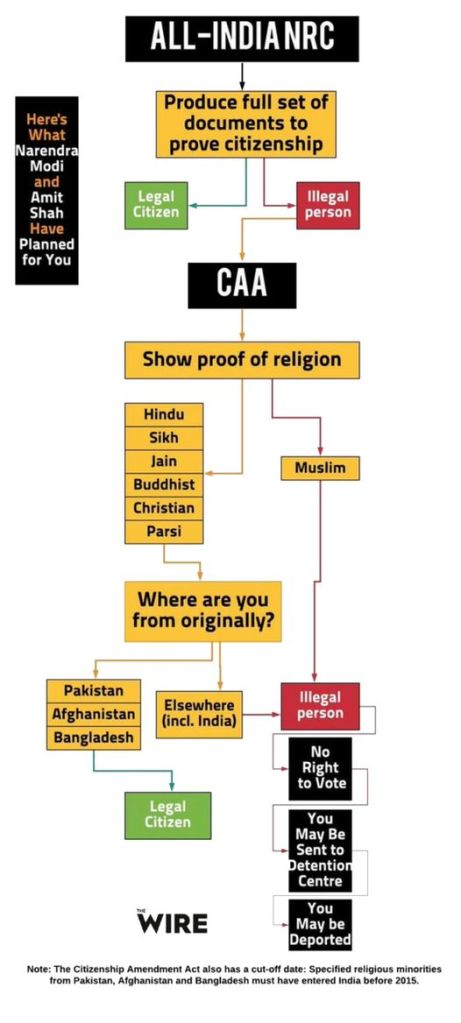
My fast today supports the Saturday fasting chain intiated by Mrunal Mathuria. Our protest today is directed against CAA and NRC. For those interested, I share below parts of my speeches during the anti-CAA protests in LA in 2019, explaining these laws and their implications:
Foreign nationals, including Indians, can reside in the United States via four main channels: citizenship, wherein one holds a passport obtained by birth or by naturalization, legal permanent residency, wherein one holds a green card, legal temporary residency through a variety of visas – work, travel, etc. – requiring US entry and departure to be documented in one’s passport by an I-94 record. The last means of residency is as an undocumented immigrant, who can register themselves as a refugee fleeing persecution. These asylum seekers are sometimes erroneously called illegal immigrants. They do not carry legal documentation because of their circumstances, but they are not illegal as human beings, and cannot be deported unless convicted of heinous crimes.
Because of citizenship through birth, we now have several second and third generation Indian Americans whose parents and grandparents lived in the US, but were never citizens themselves. We value and cherish these youngsters, who impress and astonish us with the ease and elegance with which they navigate disparate cultures, equally at home with Indian friends and relatives, as they are with American school friends and colleagues of all extractions. We do know, however, of some Americans who would view these marvelous children with suspicion and contempt. People who would consider them unscrupulous or low-IQ merely because of the color of their skin, subjecting them to a steady stream of micro-aggressions that have a cumulative effect on the psyche, that threaten to break our children for no fault of their own.
Now imagine a scenario, four centuries from now, in which descendants of immigrants who came to the US from India, are suddenly declared “the other”, to be identified by the brownness of their skin, by the content of curry in their foods, by the clothes they wear to celebrate Diwali, by their Hindu religious beliefs. Imagine that they have no more voting rights unless they can provide the citizenship records of their ancestors in the US three generations ago. If they cannot, they’d risk being stripped of their jobs, their property, their citizenship. And be locked up in detention camps as illegal, stateless refugees.
It is a dystopian vision that we can hardly bear to imagine! But this is unfortunately the everyday reality of 1.9 million Assamese who were excluded from the National Register of Citizens or NRC, introduced in 2013, with the express intent of identifying and removing Bangladeshi Muslims. To qualify for the NRC, an individual had to provide documented evidence of their own birth before 1971, or that of their ancestral residence in India before 1971. This is especially difficult in places like Assam, which we all know is one of the most flood-ravaged places in the world. For historic reasons dating back to the colonial era, the poor and the destitute of Assam are largely Bengali speaking Muslims – they are systematically excluded from territory reserved for the indigenous Assamese, and forced to set up dwellings on the shifting sandbanks of the Brahmaputra. Every year the monsoon floods wash away these sandbanks, causing these people to lose their homes, forcing them to look anew for dry land below their feet. And every year, corrupt politicians use their displacement to rouse suspicions of Bangladeshi Muslims invading Assam just to garner cheap votes. The truth is that undocumented Bangladeshi migrants identified in Assam were found to be in the thousands when national level politicians were touting the number at 5 million. Prodyut Bora, a former BJP leader, rejected the theories of large-scale migration to Assam. He argued that Bangladeshis would have “very little, if any” motivation to migrate to Assam, since all indicators of development “in Bangladesh are better than in Assam.” Indeed, Assam’s Human Development Index of around 0.34 is well below Bangladesh’s value of 0.56. “What incentive today does a Bangladeshi have to come to Assam?”
Till date, 29 people excluded from the NRC have died in the detention camps of Assam. That the implementation of the NRC is flawed and premature is evident from the exclusion of close family members of reputable Indians like the 5th President of India, Fakhruddin Ali Ahmed, of Mohammad Sana Fazul, a Kargil war hero who was awarded the President’s medal for bravery, and Dr. Jitendra Nath Goswami, a scientific advisor on the Chandrayaan-2 Moon mission.
In spite of such failures, the ruling BJP Government plans to roll out an All-India NRC before the next Lok Sabha Elections, as stated explicitly by Home Minister Amit Shah. They have started building new detention camps to accommodate the large numbers of predominantly poor and Muslim residents of India who will be disenfranchised and displaced by the combination of the NRC and the CAA. This would create the biggest refugee crisis on the planet.
These laws are strongly reminiscent of the notorious anti-semitic Nuremberg Laws of Nazi Germany, which stripped German Jews of their citizenship, and set into motion their deportation. Unable to manage their large numbers, the German government eventually started mass exterminations, which we now know as the Holocaust. Gregory Stanton, president of the organization Genocide Watch, declared that the regime of Prime Minister Narendra Modi had “all the hallmarks of an incipient Nazi regime.”
Most of my Hindu relatives in India don’t see this as a warning, because they think Modi will bring pride and progress to India. They believe that is what Hitler did to Germany. I have lived in Germany for 8 years, and I know this not to be true at all. Hitler brought indelible shame and destruction to Germany that would have been insurmountable without foreign aid after WW2. Many of my university classmates refused to maintain any relationships with their grandparents because of their Nazi past. Many families destroyed old photographs because of Nazi insignia present on them. As for everyday life immediately after the Nazi regime, here is an account: “Each day, and particularly on weekends, vast hordes of people trekked out to the country to barter food from the farmers. In dilapidated railway carriages from which everything pilferable had long disappeared, on the roofs and on the running boards, hungry people traveled sometimes hundreds of miles at snail’s pace to where they hoped to find something to eat. They took their wares—personal effects, old clothes, sticks of furniture, whatever bombed-out remnants they had—and came back with grain or potatoes for a week or two.”
We are already experiencing the worst economic performance in 42 years in India. Unemployment is at a 45 year high, and our international rankings are falling across the board. It is time we opened our eyes, and noticed that our country cannot be ruled by a party whose sole strategy consists of “lighting fires so it can sift through the ashes for votes.”
Let us wake up, say “enough” to leaders who have lost their way, reclaim our strong and united India, and move it back on its original path of inclusive progress. Jai Hind!
#ChainFastingForPeace #FastingAgainstFascism #FreeSanjivBhatt #ResignAmitShah
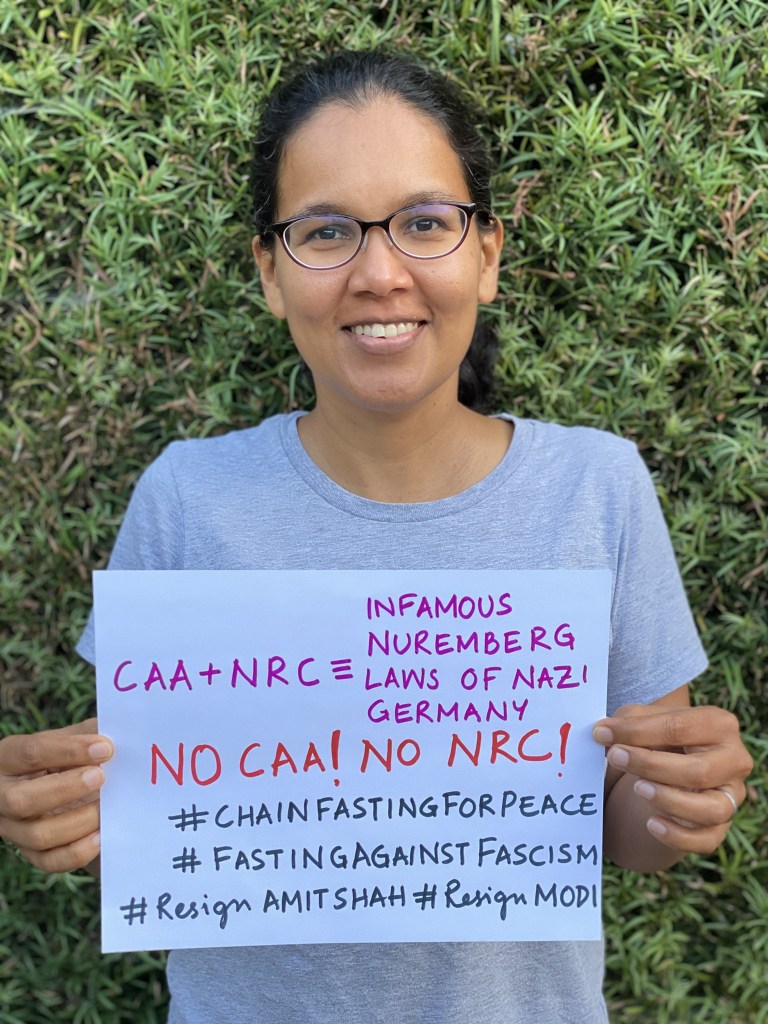
August 15: Day 3 of my fast, day 538 of our chain.
August 15, 1945, known as VJ Day, is the day on which Imperial Japan surrendered to the allies in World War II, in effect bringing the war to an end.
Today, August 15, 2021, is the day Kabul fell to the Taliban after the withdrawal of US troops after 20 years of fighting, at a cost of a trillion dollars and thousands of lives.
To me, the difference is striking! It jumps out at me that the first war was a war between (imperfect) civilizations, to whom power was important, but not at all costs. Between powers that were benevolent once their fight was over. Like two chess masters who loved the game equally and respected its rules.
The Taliban, on the other hand, play a game so depraved, that it would take an equal depravity to fight on their terms. Where the pursuit of raw power and absolute domination is the one and only goal. Where there is no room for benevolence towards those who dare be different. It is like playing chess with a tantrum prone child with an AK-47 in their arms. Is it any wonder then that the US-backed Afghan government fled in the face of their advance? Who wouldn’t agree to a life of slavery and torture if that was the only alternative to instant extermination?
The Taliban, to use the words of Donald Trump, are certainly “winning a lot.” But what good is a victory that only strikes fear in the hearts of people? That undoes generations of progress, prosperity, and peace? That no one but the victor rejoices in? I hope these questions help us reconsider what we define as success. I hope it lets us look at present-day victors, the world over, a little more critically. Is theirs a game worth winning?
#ChainFastingForPeace #FastingAgainstFascism #FreeSanjivBhatt #ResignAmitShah
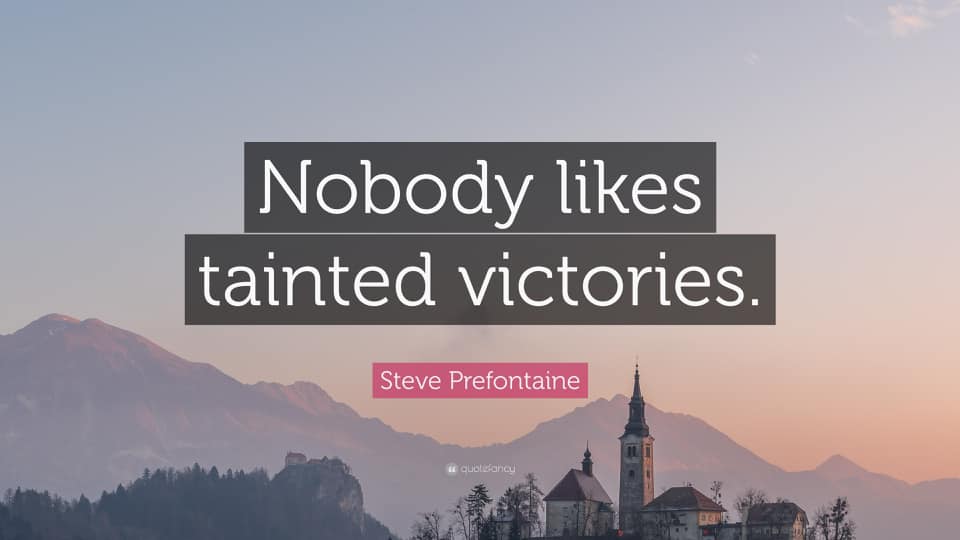
August 16: Day 4 of my fast, day 539 of our chain.
We are living through ugly, difficult times, with things going on that are beyond the grasp of the smartest, the most experienced, the best-informed of us. Maybe, as we reach the limits of our cleverness, it is time to consider the virtues of humility, tenderness and simple kindness again.
#ChainFastingForPeace #FastingAgainstFascism #FreeSanjivBhatt #ResignAmitShah

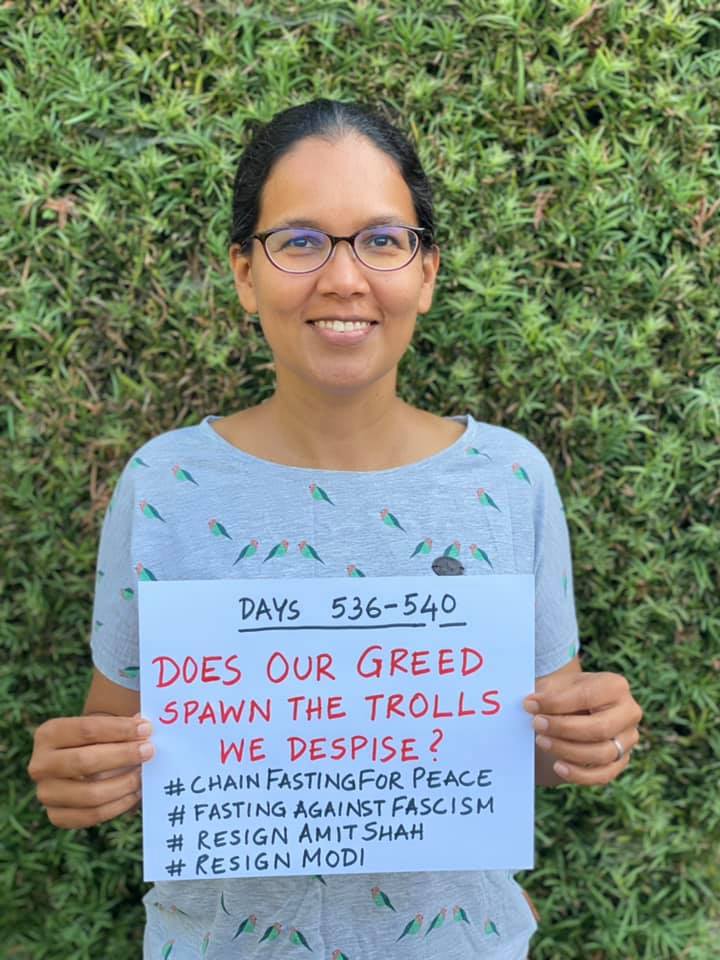
August 17: Day 5 of my fast, day 540 of our chain.
The Guardian published an article by a 24-year old young lady from Afghanistan, whose world as an English teacher and a student pursuing double degrees at Kabul university was turned upside down last Sunday as the Taliban took control. Writing on how they found themselves trapped and helpless, she described one scene that sent shivers down my spine:
“[T]he men standing around were making fun of girls and women, laughing at our terror. “Go and put on your chadari [burqa],” one called out. “It is your last days of being out on the streets,” said another. “I will marry four of you in one day,” said a third.”
This felt so similar to the kind of mindless trolling I have come to know from right-wing Hindutva groups in India. Trolls who respond to a moment of crisis not by lending a helping hand to make it mutually more bearable, but by looking for someone who is worse off, and making them feel even more miserable. As if the sense of control they derive from subjugating the weak gave them a momentary sense of relief from the impending disaster awaiting them all. A cannibalistic glee at being able to devour another person before being ultimately devoured oneself.
Why? What desperation drives people born as beautiful loving children to completely lose hope in their ability to do good? How can we prevent such desperation? How much does the greed of those who have enough already contribute to it?
These are questions I cannot stop asking myself today. And our fasting chain is a constant reminder not to stop asking uncomfortable questions of ourselves and others around us – before we reach the point of no return.
https://www.theguardian.com/…/an-afghan-woman-in-kabul…
#ChainFastingForPeace #FastingAgainstFascism #FreeSanjivBhatt #ResignAmitShah

 Chain Fasting For Peace