I am keeping this fast in support of all those people who are facing the consequences of covid lockdown… Especially middle class because they are more hesitant to ask for help…. Difficult for many of them to even pay the school fee…. 😢😢😢
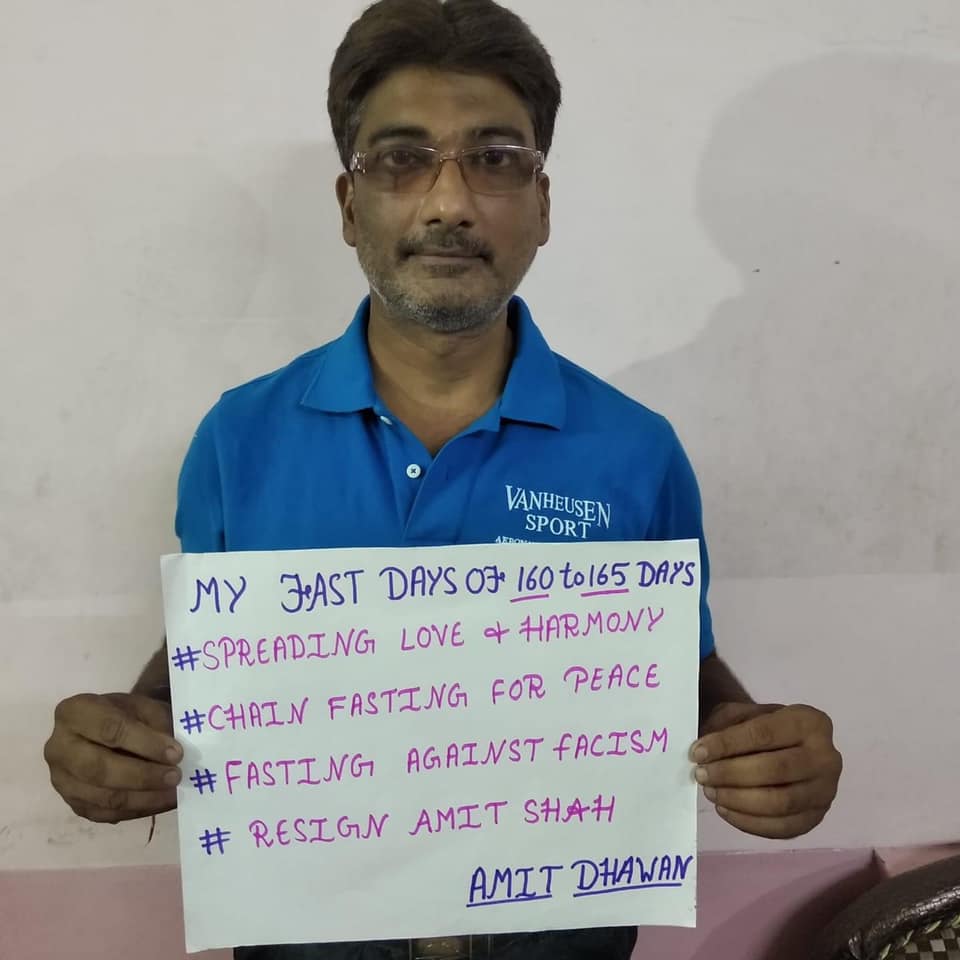
August 5: Day 3 rd of my fast, day 163 of our chain:
Will there be any sacredness left in this place where the temple is going to build up after shedding so much of blood…? Can we ever get inner peace at such a place? How Rama will breathe himself in this temple?… What a pity who think they have won the battle of Ayodhya😢😢
August 6: Day 4th of my fast, day 164 of our chain:
Another Nirbhaya incident in delhi😢😢
We are not able to give a secure and safe environment for women…. What a shame….i pledge that I will try to give safe environment to all the women around me… No matter where I go…i promise no women will feel insecure or unsafe in my presence and I promise I will raise my son in the same way… 🙏
August 7: Day 5th of my fast, day 165 th of our chain:
More we gonna destroy the environment.. More we will face one or the other pandemic situations… It is time to wake up and to become a guardian of the nature… Nature was nurturing us as well as healing us now the time has come to pay back to the nature by nurturing her and healing her wounds given by us
July 19: Day 1 of my fast, day 146 of our chain: **Long post alert
So many Indians like to fantasize about leaving the country to lead a better life elsewhere. In a readymade system, with readymade safety nets and readymade justice that will let them thrive. Yet, when they do finally make it out, they – especially those used to and yearning for differential privilege – are often so miserable. Because their rigid, self-centered worldview won’t let them fit in: thus is born the NRI bhakt. Admired only by other bhakts. Hobbled forever by an inability to add anything of true, lasting value to the world. Why are we producing so many bhakts?
In all seriousness, the problems ailing our country seem so intractable, and the divisions among our numerous peoples so deep-rooted, that it is has been difficult for our most committed, well-meaning leaders to formulate, let alone achieve, even the simplest common goals. We seem to have even forgotten if we ever knew what it means to work towards a common goal that benefits us all: as I write this, I think back to larger family gatherings where the uncles-in-charge bickered about where to go sightseeing until it was too late to go anywhere at all. Where family discussions become insurmountable tugs-of-war instead of a platform to simply communicate different perspectives. Where the world is seen in black-and-white, where I am white, and anyone who disagrees with me is black, and where, to cede to a new shade of grey is to accept defeat, to invite ridicule and shame, to become a social underling. So stick to our guns we do, in fear of the imagined, exorbitant cost of compromise.
Granted, the cost-to-benefit ratio of pursuing a community-oriented goal feels exorbitant when there is no informed consensus on what would benefit us all. We go out and get fancy degrees, but we get those only to add to our defensive social arsenal. Who cares about informed consensus?! This widespread blind-spot is definitely proving to be a lucrative vulnerability that our current leaders are leaving no stone unturned to exploit. They are simply replacing any semblance of informed consensus that the likes of Nehru tried to foment through education and modernization with mob-driven majoritarianism – be it through superficially unifying narratives of Vikas and Hindutva, through the manufactured consensus of hatred against Muslims, Dalits and the poor, or through the mind-numbing personality cult around Narendra Modi.
And so, in a country that exports top-notch doctors and health-care professionals, we have a runaway coronavirus crisis. With clear repercussions beyond just health, as millions of Indians are pushed into endemic poverty from the economic impact of a mismanaged lockdown. Our elected decision-makers have made it clear to anyone who has been paying attention that they actively want an impoverished populace. Just like so many Indian families want less educated, almost juvenile brides for their sons. Like teachers in sub-standard educational institutions want dull students who will mindlessly regurgitate what they are taught rather than thinking independently enough to ask questions. And so we see our brightest, most conscientious citizens – the ones who dare to care against all odds – brutally penalized in an attempt to silence them, to silence us, and to teach future generations to fear their own voices.
Through their brutality, our rulers want to make us as afraid of our inner voices as they are. And the rest is lulled into compliance, through a deluge of “positive” sounding, celebratory, nationalistic misinformation if they belong to the Hindu-Savarna in-group, and through intimidation and gaslighting if they don’t. Can we turn this wheel around? I think we can. We have kindness, truth and love on our side, while they only have endless greed on theirs. Our journey is full of meaningful lessons, lasting insights, and diverse opportunities, while theirs is a meaningless march towards a soulless, suffocating singularity.
Yesterday, I wrote about the elusive nature of informed consensus in India. I’d like to continue mulling over just consensus today, forgoing the “informed” qualification for the moment. I think the universal will to preserve one’s life by nourishing one’s body and securing its physical safety is the most basic form of consensus that unites us all, irrespective of where or when or as whom we are born. It is what drives minute-old turtle hatchlings to rush to the ocean and blind newborn kittens to effortlessly latch onto the mother cat’s teats, not unlike human babies whose immediate impulse after birth is to locate and suckle at their mother’s breast. Nature unites across the most disparate species, and provides abundant unifying consensus, so why do we invent all kinds of classifications amongst each other that make it harder and harder to share common goals? Is it because nature also rewards a certain degree of conquest? For food, for procreation, for survival? That favors oneself over all others of one’s kind?
But in the long run, nature favors neither the wolf, nor the sheep, neither the predator, nor the prey. All it seems to preserve is a balance. Whenever mankind has strived to recognize and respect this balance, it has prospered. Is it a surprise that the most important civilizations in the history of mankind have produced vast arenas of learning, producing timelessly universal art, wisdom, and technology? And that the same civilizations have been ruined by conceit, greed, and their ultimate culmination: war? To borrow from Thomas Mann, war has always been merely the coward’s escape from the problems of peace.
What are the problems of peace that we find so difficult to face? Could those be the problems of balance, the balance that maintains our harmony with nature? When we hurt this balance by getting seduced by the lure of power – the power that comes from being number one, better than all our peers, at whatever little games our part of humanity is vested in for the fleeting moment of our lifetimes on the vast timeline of our common human evolution?
No sooner than we try to bottle the infinitely unknown nature of this exquisite universe we inhabit into our limited ability to comprehend it, do we start to trade our burning curiosity for limiting certainties, our spirited inquiries for dead dogmas, our ingenuity in the pursuit of excellence for entitled complacency. So where do we stand at this moment of time on this evolutionary spectrum? The signs are all around us. Where we go from here depends on our collective choices. And that is where the “informed” nature of the consensus we reach eventually becomes critical. To be mulled over tomorrow.
I remember a joke from the 90s, probably even older: it was about a student from India who was trying to slackline with a group of friends at his U.S. university. After falling off the line a few times, he simply picked up his backpack and a bunch of books, got back on the line, and walked straight across, much to the amazement of his friends. When asked how he managed, he said he just had to imagine his daily walk to college in India amid the general chaos on his way, constantly dodging potholes, people, animals, and traffic, laden with a heavy backpack and an armful of books.
I find this typical: Indians are so good at dealing with things most other people in the world would find maddeningly difficult if not impossible. The seeming ease with which we navigate everyday hazards like endless traffic snarls, air pollution, noise pollution, potholed streets, lack of public sanitation… feels like a miracle, until we realize that it isn’t. It is just resentful resignation.
Rarely have I seen a smiling, carefree, relaxed face on my native Mumbai streets. Our public spaces are war-zones. Most of the time, everyone is hyper-alert, faces contorted to wary grimaces, charging to claim their space before anyone else does. After a few years abroad, it was difficult not to wonder why we couldn’t simply organize ourselves better than to tolerate so much loss of time, energy and personal well-being in our day-to-day lives. If families who couldn’t dream of owning a bicycle just two decades ago now had more than one SUVs clogging the street in front of their apartment complex, it was puzzling why they couldn’t adopt better driving conventions than 20 years back. If they could adopt imported habits in eating, dressing and other forms of consumption, why weren’t they copying basic decency towards others in our public spaces?
It becomes impossible not to see how, while so many are deeply engrossed perfecting a pretense of living like imagined royalty in a western city of their dreams, our sewage continues to be cleared manually. The friendly cobbler at the traffic crossing from 20 years back has aged a lot, but he still sits under a flimsy piece of withered tarp, hunched over fancier shoes, but with the same rusty tools, earning little more than a pittance for his skills. The household help still teeters on the edge of subsistence. Most families still offer them last night’s stale rotis with their chai after hours of labor, even if there are enough fresh ones to go around for everyone. In separate dishes that no one else uses. After spending a day at the chic new mall, with fancy meals in international restaurant chains, after a chai latte at Starbucks for Rs. 500 (when a real chai could be had anywhere else for less than Rs. 20), it is considered too un-Indian to smile and say ‘hello’ and ‘thank you’ to the cab driver.
It is as if the well-to-do in India have sworn their allegiance to vacuous navel-gazing, doing their best to avoid taking notice of those they consider “below their station”. And those others, snubbed beyond human tolerance by those above them, pass on the “special treatment” to those below them… to what end? What purpose does this whole charade serve? Other than putting everyone in a foul mood, dividing us needlessly and endlessly, forcing everyone to live a life of make-believe – sandwiched in an existential space delimited by unchecked power over those “below” oneself and unquestioning servility towards those “above”? How does one generate informed consensus in a social climate like this? When a substantial part of our self-imposed idea of Indian-ness requires us to set artificial limits on ourselves and everyone else we come in touch with?
Why don’t we give ourselves a pause? Stretch ourselves beyond our socially allotted boundaries, so that we can absorb, process and respond to the real world around us. And let others – all others – do the same. Be a little nicer, more decent to each other. Just the side-effect of uplifting our collective mood would work wonders for everyone’s individual productivity. And increased productivity in a nation of 1.38 billion means an enormous boost to our overall fiscal revenue, which under competent, capable leadership, would allow us to invest more in our people, making it the self-propagating virtuous cycle we all deserve!
Over 2250 years after Aristotles declared the Earth to be a sphere, and Eratosthenes accurately computed the circumference of the Earth, in a day and age in which images of the Earth from space abound like confetti, and close on the heels of having captured the first image of a black hole, it is unthinkable but true that there still exist people who think the Earth is flat. Who say without the slightest hint of irony that they didn’t care for high school physics because they already have a God-given brain that they are happy to preserve as received. I would not be surprised if they’re the same people who resist the idea of evolution: God’s taking care of everything, so why do anything for ourselves?
I met someone fitting the above description today. Online. Someone who stridently defended his belief in a flat Earth, and clearly expressed his contempt for books and science. Someone from my hometown of Mumbai – a fact that shocked me to the core. Had this person been born a Hindu, they would certainly be a Modi Bhakt today. Because Bhakts are characterized by their comfort with a general lack of information, a bravado driven by their unshakable belief in their God-given qualities, and a blind acceptance of and devotion to authority, so long as it favors them at all times. At all costs.
I realize now more than ever why Nehru felt an urgency to sow the seeds of scientific education, secularism and modernization in the nascent India of 1947. If we have any semblance of informed consensus today, it is thanks to his vision. For the past three days, I have been thinking and writing about the need for an informed consensus in Indian society to defeat the scourge of fascism brought on by the Modi-Shah regime. This process brings me to the very edge of the great divide between us and them, and I don’t know how easy it will be to build a bridge:
Us, inspired by the big picture with its endless possibilities. Them, scared by the same endlessness, fearing unknown dangers. Us, wanting to create safety nets for all to thrive without constantly having to watch their backs. Them, wanting to position their differential advantages so that others are more scared of them than they are of the others. Us, thrilled by the promise of adventure and discovery that life has in store for us. Them, trying their best to make life predictable. Us, living a life we love, in gratitude for the providence, beauty and magnificence of nature, feeling deeply enriched by new experiences and diverse acquaintances. Them, living in fear of unknown dangers, preparing forever to viciously defend themselves against anyone who falls outside their monoculture.
The only way to build a bridge and to win more of them over into our fold would be to recognize how scared they are. And to conquer their fears with our love and gentleness. With patience and generosity. Anything else we do will only make them more scared, more defensive, more prone to retreating into their hard-walled shells, adhering even more vehemently to the reality-defying beliefs that they seek all their comfort in. At the same time, we are certainly exposed to the real danger of their mad, disproportionate defensiveness: we need to find each other, support each other, nourish each other’s hearts, minds, and souls.
But at the end of the day, we need to trust and stand by our own sentient voices, our conscience: that is what separates us, the living, from them, the living dead. Let us pay heed to our own Gandhi, who wrote: “The only tyrant I accept in this world is the ‘still small voice’ within me. And even though I have to face the prospect of being a minority of one, I humbly believe I have the courage to be in such a hopeless minority.”
In his best-selling book ‘The Demon-haunted World’, Carl Sagan writes these well-known lines:
“Science is more than a body of knowledge; it is a way of thinking. I have a foreboding of an America in my children’s or grandchildren’s time — when the United States is a service and information economy; when nearly all the key manufacturing industries have slipped away to other countries; when awesome technological powers are in the hands of a very few, and no one representing the public interest can even grasp the issues; when the people have lost the ability to set their own agendas or knowledgeably question those in authority; when, clutching our crystals and nervously consulting our horoscopes, our critical facilities are in decline, unable to distinguish between what feels good and what’s true, we slide, almost without noticing, back into superstition and darkness.”
While the U.S. under Trump is teetering on the edge of this dark future, the tragedy of India under Modi is considerably worse. First, because India is responsible for the destiny of a sixth of the world’s population, a whopping 1.38 billion souls. And their children and grandchildren. And even more importantly, because we aren’t entirely out of the dark ages yet. If the U.S. is a young adult, we are still toddlers on the path to achieving an enlightened way of living in harmony with reality.
Fascism is like a malignant brain tumor. Even if there exists a small probability of eventually surviving it, the setback for a still budding child is immeasurably greater than for an adult. Modi has to go before the damage becomes irreversible. Like our dear brother Saket Gokhale said yesterday: “You lose every battle you choose not to fight.” We have watched him do it all alone long enough. Let us not just be spectators watching a few individuals like Saket, as they carry the heavy burden of this struggle for all of us. Let us stand in solidarity with our most vulnerable, and fight back together in every way we can – big or small! It is time to become the heroes that we want to rescue our world.
Unbelievable that the chain has been going on for so long now. People may wonder: Why? Similar to the fatigue that sets in with COVID isolation, one is tempted to let the guards down and just let it go. However, the risk can be high, minds get numbed when seeing human misery all the time. Let’s never normalize it. Shout-out to Suniti Sanghavi for shepherding us along, let’s keep this fight going.
Progression to Facism is often silent and slow, slipping below the radar of most people. A key ingredient is a lack of empathy within the majority of the population, something I can clearly see in India. Why is Mein Kampf sold almost everywhere? What do people see? It shocked me more than 10 years ago already but the rising blind patriotism and Hindutva puts it into a different light now. There is an insecure yearning for national pride. There is no good way out of this but through consistent protests and resistance.
https://www.netflix.com/title/80138915 nicely shows how a small group of fanatics can take over a country little by little, exploiting fear and hate. The only thing that keeps me hopeful is the truism „whatever you say about India, the opposite is also true“. There are so many intelligent, talented and compassionate people, I hope they will win and the country will put humanism above short term capital gains or a false sense of renewed pride again.
Even though this fast isn’t easy, I find it easier than Ramadan fasting (when I joined Suniti Sanghavi for a single day). Not being able to drink at all as well made it much harder. The spiritual meaning can’t be more meaningful though. Fasting now is not only a protest but also creates compassion for those in need and who suffer most of their life. My fast will end in 2 days and just knowing this makes it much easier. Others don’t have this privilege and for those we protest.
Encouraged by discussions at home and my potential insight into my home country’s (Germany) history, some more thoughts about the insanity of persistent admiration about Hitler’s Germany (particularly in India). Commonalities are the yearning for “strong leadership”, not unlike in the US now and Brazil. Also, the myth of uniting the masses towards a common goal, thereby making the nation stronger.
The truth is that this kind of strength is always short-lived as it just tries to put a band-aid on more complex issues. This path is a dangerous one if combined with hatred and scapegoating of minorities, as the Holocaust shows. One has to see and be aware the risk of the path ahead, even if some consider it exaggerated.
To me, the exceptionalism of India is how it has always absorbed different cultures into vibrant communities. India has been a melting pot long before other nations. The exceptionalism of the US is similar, a beacon of hope for other people as beautifully illustrated by the Statue of Liberty. Both are in danger of losing their exceptionalism by giving in to divisive rhetoric, small-minded goals and confusing hard-line politics with strength.
Today on the 1st day of my fasting 2nd time as part of this chain….having headache as this is the first day and body has it’s own reactions….but I am very happy to be part of this chain fasting for many reasons…
I being this fasting chain with a wish for a sensitive society/ people…
I wish for all of us to be more and more sensitive to our children, parents, partner, friends….
we take a pledge that we will not even in joke make any person feel bad about himself…
we will not make fun of each other….
and we will not support any cheap scripted entertainment….
not to make anyone a laughing material which can hurt the person….
if I want a society which is sensitive then I have to begin from my self…🙏🙏
Today is dedicated to Justice, when a person who was arrested for his involvement in terror activities was released whereas Zafoora who is pregnant and was protesting against CAA is being held in jail….And so are many other activists
Today is dedicated to Sanjeev bhatt….he should be released …what was his crime? Is it much bigger than Davinder Singh’s crime who has been granted bail even after his involvement in terror activities….I demand justice for Sanjeev bhatt who is an honest officer….
Today is dedicated to: I as a citizen demand a secure life for every one…but more and more I see our country is becoming unsafe for women and children…..I demand from our gov to give a safe environment to the women and our children….🙏 And all the minorities should get a safe environment rather than the fearful surroundings….every life is precious ❤
Today is dedicated to a question about the environment and nature….how to live with nature without destroying it….what is progress? And what is the cost we are paying for this so called progress….what is at stake?…is human life so important that nothing seems more important than that? Can we live without this nature in these concrete boxes? We are disconnecting ourselves from nature and that is not good…..it is scary…. 🙏

 Chain Fasting For Peace